Anchoring Authenticity for My Personal and Business Brands
 The raw, direct, and less-polished authentic personal brand In the last 4 years, I have lived and breathed authenticity into my personal and business brands like never before.
The rush behind it was not by design; it was a choice that I’ve made to expand my personal growth.
Leading with an authentic personal brand was not easy in the beginning, because I was trying to understand and define what “authentic” means to me, by doing the inner work that gives me permission and freedom to fully express who I am.
There were moments that I had doubts about how others will accept my truths and vulnerabilities.
Being vulnerable put me in spotlights that I felt I had to be ready to defend my thoughts and protect my safety, on things that were normally private to me are now made for public consumption.
Over the years, as I peeled back the layers of my story steadily and courageously, I’ve built confidence in my voice, and that becomes an extension of my personal brand, which permeates into my business brand.
I’ve learned a lot about myself, and at the same time, a lot about others because people opened up when I opened up.
Modern World Craves Real Person In Full Presence
In this modern world where we have access to tools that can transform an image from a normal person to one that has a scripted edge and feel to it, it makes the craving for “a real person” even stronger.
The identity that I’ve grown into and embraced is one that reflects my true self: calm, grounded, intentional, forgiving, full of self-love and love for others.
My authentic personal brand has become a love connection to my business brand because they’re in separable.
A strong, authentic personal brand in full presence influences my energy, my thoughts, and my actions…
…I’m not afraid of dealing with messiness in my life
…I’m trusting my intuition fully
…I’m able to let go and forgive
…I’m able to lead without constant judgement of myself and of others
… I’m able to love again even when I feel I was broken
…and I feel free in amplifying my voice with greater intentions
The raw, direct, less-polished, authentic personal brand is raising my “human premium” that I won’t trade it for anything else.
Who is with me?
 Marketing During Uncertain Times “Value-First” and “Human-Centered” Marketing Wins During Uncertain Times
During the past few weeks, the heightened chaos and instability happening in Minnesota and around the world woke me up.
I was having a hard time deciding on what topic that I want to share this month for my blog.
After doing some reading on concerns other business owners have, I’ve decided to write something to help some of you who may be in the same situation as I do: How do we continue to market our business during uncertain times and not make it tone-deaf and too sales-oriented?
In my opinion, I believe the most effective approach would be using “value-first” or “human-centered” marketing.
Value-first means that you offer values to help people feel better, lighten their stress level, reduce their loads, or help them get productive even when they may not feel motivated.
Human-centered means that you focus on your customers with empathy, kindness, and forgiveness that will make you a better person to help them navigate reality.
This means Instead of pushing products, you’re genuinely helping people navigate the chaos and messiness around them, while building trust that naturally leads to brand affinity and sales over time.
What are some ways to articulate “value-first” or “human-centered” marketing?
Consider these nuggets:
- Lead with useful content and support. Share practical information related to your expertise that helps people solve real problems they’re facing right now. If you run a financial services firm, create content about managing uncertainty or stretching budgets. If you’re in wellness, address stress management. The key is making it genuinely helpful, with less focus on sales pitch.
- Acknowledge reality without dwelling on it. By acknowledging reality with a simple recognition goes a long way. Something like: “We know these are uncertain times” before explaining why you’re there to help. Then move forward constructively rather than amplifying anxiety.
- Emphasize community and connection. People crave belonging and love when the world feels chaotic. Create spaces for customers to connect with each other, share stories from your community, highlight how communities coming together can strengthen faith and trust to move forward. This builds emotional bonds that transcend transactions.
- Be transparent and reliable. In uncertain times, consistency is comforting. Communicate clearly about your offerings, pricing, and availability. If you need to make changes, explain why. This reliability becomes a form of value itself.
- Show rather than tell your values. Instead of grand statements, demonstrate what you stand for through actions, such as lending a voice to someone calling out bad behaviors, supporting marches that express public opinions and your own sentiments, and serving customers with empathy. People notice authenticity and real emotions – which will make them value you even more.
Are these tips helpful for you to navigate your marketing approach in uncertain times? Drop me a line if this resonates and share with your friends and colleagues.
ABOUT PRETTY POKETS:
Pretty Pokets™ is woman-owned business founded by Madhu. Before Madhu started her entrepreneurial journey, she worked as a hardware engineer at Intel. Motherhood served as the catalyst that drove Madhu’s passion as new mom into a business owner creating a real product that had a bigger purpose. Because Madhu firmly believes that women need accessories that provide confidence and simplify their day-to- day lives while adding the much-needed style, her mission is to add incredible value to women’s life by designing and creating intentional products that find harmony between usefulness, common sense, and fashion.

THE RESULTS
Pretty Pokets has made the transition from womanhood to motherhood pretty by empowering moms with practical and elegant products that they are proud to wear and would not leave home without.
Through working with us, we were able to help Pretty Pokets completed their Kiva Crowdfunding campaign from start to finish, and received amazing community support. Her company was funded in 1.5 month since the campaign inception, and gained sufficient funding to move forward with her product expansion.
“Pretty Pokets was was funded in less than 45 days—just before Christmas. It was truly an amazing experience, like having the best gift of the season arriving early. Thanks so much Jenny, for all your help!” — Madhu Challa, Founder and CEO, PrettyPokets
PRETTY POKETS’ CHALLENGES
As a first-time, woman business owner, it was hard initially for Madhu to get funding that will allow her to build prototypes and ultimately develop and expand more product lines to sell to her customers. She took courage to address a big pain point for new moms. Her idea turned into a Patent-Pending Diaper Bag that was useful, functional, and fashionable. She was able to successfully build her prototypes and produce trendy, fashionable products that got real traction. She was ready to move into her next stage of product expansion and looking for funding to support her inventory build and new customer orders.
SOLUTION
We worked closely with Madhu to develop her business profile and campaign pitch that were featured on the Kiva micro-lending platform. We listened carefully to her story and brought curiosity and creativity in our work to help her craft a simple, yet compelling story for her Kiva campaign, which provided tremendous credibility for her business in the Kiva community.
To top this off, because the campaign was launched close to the holiday season, getting attention from borrowers felt like an impossible task. We made it easy for Madhu to work with us and followed up with her throughout the campaign. Together, we worked on pertinent marketing and word-of-mouth support to push the campaign through, until Pretty Pokets was funded – just before Christmas.
 PC: Mohammadreza Charkhgard from Unsplash A (Secret) Tip to a Successful 2026
A new year is arriving upon us!
The quiet time between Christmas and the New year is a good time to reflect deeply on what we can do better next year, in terms of setting ourselves up for abundant success and happiness.
I want to share a (secret) tip from my knowledge treasure box … gathered form my recent reading of “Atomic Habits” by James Clear. Clear wrote in one of the chapters that “perseverance, grit, and will-power are essential to success, but the ways to improve these qualities is not by wishing you were a more disciplined person, but by creating a more disciplined environment.”
This quote woke me up, not because I’ve been sleeping through reading his book (Haha!), but because of the powerful truth behind these words. I can certainly attest to what he said, connecting it deeply with what I do and how I am helping some of my early-founder clients to realize that the formula of success goes beyond having perseverance, grit and will power.
Taking Clear’s advice, my follow-through action is to transform my business and marketing roadmap for 2026 into visual cues, that will keep me honest and focused on my goals, marching towards progress, enjoying the process, and celebrating the outcome.
For 2026, I will keep these top 3 goals front and center:
1) Business Growth: Engage with companies whose sustainability spirit and actions speak louder than words. Work with them to amplify their stories and the goods that they do to elevate their brands and environmental stewardship.
2) Professional Growth: Continue using AI together with my intuition and superpower to do my best work.
3) Personal Growth: Become a better reader by reading 10 minutes, each morning before work, from a book that I want to learn from.
I will print these goals out and put them in front of my work space, using them as environment cues that will create good habits for me, while making other bad habits less visible.
Let’s go and create a disciplined environment that will set you up for abundant success and happiness.
What are some of your secret tips for a successful 2026? Love to hear it!
“A Good Coach Takes Your Players to a Better Place that They Cannot Go Themselves” ~ Dick Gould, Head Coach, Men’s Tennis, Stanford University ~
A Good Coach Takes Your Players to a Better Place that They Cannot Go Themselves
This is one of the most heart-felt advice that I had heard from a coach panel that I attended at the Stanford’s Sports Equity Lab a few weeks ago.
In a similar light, this guidepost can be applied to us as well: business owners, entrepreneurs, founders, marketers, engineers, teachers, service professionals, and more.
We all have the power to take the people that we want to serve or care about to a better place that they cannot go themselves.
This is not to say that our customers don’t have the ability to get there themselves. This means that we can take our experiences and superpower and build the framework and lead them onto pathways to help them get there faster and go further.
Based on some of my present experiences working with customers who want to create a product and make sales the next day or the minute that they launch, is that they are lacking this overarching guiding principle in their success formula.
In fact, “helping our customers go to a better place” is an under-communicated experience. I find that in this digital age, business owners or founders who want to acquire customers are forgetting to invest time to define that experience and articulate them to their prospective customers.
What Does “Taking Your Customers to a Better Place” Mean?
First and foremost, let’s define what “a better place” means to some of us.
In my opinions, to define a better place, you’ll need to start from ground up. Meaning that you will need to understand where your customers are coming from, and learn what they’ve been doing to get to a better place, yet they haven’t been able to get there themselves on their own efforts.
Next, you will need to define the “better place” in your product or service.
For examples:
If you’re working with founders who need to get to proof of concept, a better place where they can finally show proofs of their products truly working to benefit their customers in repeatable trials. This better place will help founders get more funding from investors, or get more customers adopting their products. Your product or service needs to show what and how you are going to help your customers get there.
If you’re a physical therapist who needs to help your customers ease their pains in their joints or hips by finding the source of pains and minimizing it through proper movement and stretching, you will need to promote your philosophy on pain healing, and talk about how you have helped other patients going from A to B. B is a better place that your patients are free from pain by following the repeatable stretching or exercises that you’ve shown them, and they can repeat the same techniques themselves independently at home.
If you are building an AI tool to help SMBs be smarter in driving process efficiency and data-driven business decisions, then you will need to take them to a better place where SMBs become less hesitant in using AI technology to replace what they do semi-manually, and get into the habits of using AI to analyze raw data and can further refine to help with their decision-making process.
Overall, the important thing is that your product needs to help your customers make that transition, the leap, or the change that will transform their habits, thoughts, behaviors, and/or expectations to get there.
Defining “a Better Place” Requires a Deep Understanding of Your Superpower
The magic in helping your customers get to “a better place” lies in knowing what your superpowers are, or what superpower your product has.
A good starting point would be to work on your vision and human story. When you have these two anchor pieces defined, you can then approach other aspects with courage and un-wavered commitment.
If you’ve been having troubles in identifying your superpower or your product’s superpower, I am here to help.
With my help, you’ll get to understand at a deeper level on what business that you want to create, how it will take you to a better place, getting closer to your goals and achieving your Ultimate Prize.
So, you’ll feel energized, empowered, and have all tools to be successful, while achieving impact, income and personal freedom all together.
I look forward to inviting a few founders to participate in my next LaunchFit accelerator program. Stay-tuned for more information that I’ll share out in November.
With Gratitude,
Coach Jen
 Fundamentals and Healthy Mindset Are Key to A Successful Entrepreneurial Journey Fundamentals and Healthy Mindset Are Key to A Successful Entrepreneurial Journey
This past September, I took part as a panel on the Founder Forum Series hosted by San Jose State University (SJSU)’s Office of Innovation and SpartUp Incubator.
We had over 50+ student entrepreneurs in attendance. The moderator asked thought-provoking questions that had kept me and other panelists on our hot seats!
During Q&A, one of the student entrepreneurs asked about “How to be Ultra Successful” on their journey.
My immediate response was that “Ultra” successful is not a realistic expectation for every entrepreneur. While we’ve read about many successful entrepreneur stories, we don’t see failures being amplified.
This kind of narratives distort the truth about being an entrepreneur and doesn’t help a founder become resilient, patient, and committed to their journey even when times are tough.
A good baseline to cultivate a rewarding and successful entrepreneurial journey is to start with focusing on your vision alignment, fundamentals, and a healthy mindset.
Vision Alignment
Vision acts like a North Star for a young start-up because it helps a company stays on course based on their most trusted beliefs that they are creating and building something big and have impact for their company, as well as to the community and society as a whole.
It’s important in the beginning to align your work with your vision, especially during formative years when the company is forming teams and getting their products ready to go to market.
It will become less of a focus once the start-up and its team are in alignment on where they want to go, because consistent and steadfast execution on its vision and strategies will become keys for business and entrepreneurial success.
The Fundamentals
I believe that founders need to set up their company and team with strong fundamentals from which they can build on for incremental success. Fundamentals consist of:
- Vision
- Problem and solution validation
- Market understanding
- Business model clarity
- Minimum Viable Product
- Team skills and culture
- Funding
Having strong fundamentals will help a young company learn fast and fail fast. Failures are lessons in disguise and will allow start-ups to build a better mousetrap, put together better systems and processes, and develop personal growth and leadership to tackle challenges coming their ways, without losing hope on success of their products.
The Mindset
On top of learning to make their business viable, a young team needs to develop soft skills such as having an open mindset; being approachable, coachable, and authentic; not afraid to ask for help, and apply those soft skills on a consistent basis.
Founders should not be distorted by narratives that provide falsehood on the reality of their entrepreneurial journey.
Not every start-up founder will have a “Unicorn” company, but every founder can become great by being determined, focused, optimistic, making relevant product meeting customer needs and living life.
Being realistic allows founders to admit mistakes so changes can be made with their products based on data and market demands. It’s a healthy way to lead an enduring successful company.
Uncovering Importance of Essentialism
This past two weeks while I was vacationing with my family in the North Bay, every day, we chose an activity that would get us connected with the outdoor – exploring nature, soaking in the sound of waves, listening to the fog horns, and watching sea birds soared above the water. We wrapped up our day by slowing down, listening to songs from Aretha Franklin, Neil Diamond, and Los Lobos from an old record player.
After a few days of having to make lots of decisions on how we would spend our time relaxing
 while being rewarded with experiences of new places that we had traveled, I found that I was a little exhausted by planning many activities to focus on, and forgetting to enjoy the spontaneity of things. while being rewarded with experiences of new places that we had traveled, I found that I was a little exhausted by planning many activities to focus on, and forgetting to enjoy the spontaneity of things.
When I was able to sit down at night and read up on “Essentialism” by Greg McKeown, it dawned on me that we need to practice “essentialism” not just in our work space, but also outside of work — especially when we needed to tune into our vacation mode.
What Does Being an “Essentialist” Mean?
The term “Essentialism” advocates the core mindset of an “Essentialist.” Being an “Essentialist” means that “we choose to”:
1) Explore options before making a decision on where to spend our time and energy
2) Eliminate trivial from many to focus on what’s important, and
3) Remove obstacles and make execution as easy as possible
By examining the core mindset of an “Essentialist,” I find that I’ve already embraced a similar mindset because I, too, care about where to focus my energy and time to create the most impact and serve at the highest level, instead of trying to do everything that’s been asked of me.
 By the same token, this is a similar mindset that I’ve been advocating with my clients, in their business, marketing strategy, and priority setting – by focusing on things that they love to do and doing them well. By the same token, this is a similar mindset that I’ve been advocating with my clients, in their business, marketing strategy, and priority setting – by focusing on things that they love to do and doing them well.
Because of the “essentialist” guiding principle that I’ve adopted and practiced on a consistent basis,
I’m seeing that I’ve experienced less burnouts.
I am able to prioritize my energy first so I can have the overflows to serve others at the highest level.
I have also found that I’m more consistent in setting boundaries and following through on them, and people around me respect this new paradigm shift.
Shifting from “We Have To” to “We Choose To”
The teaching moment for you and me is that if we stop letting ourselves believe in the mindset that “we have to,” and shifting it to “we choose to,” you’ll notice that:
1) Less is more and better
2) Pursuit more essentials and less trivial, and
3) Life is better when we do great work that matters to our happiness
This is the model of an “Essentialist.” I think you, too, can glean from the powerful mindset of an Essentialist and develop your own model that will work with your business, marketing, professional and personal endeavors.
I’m confident that you will achieve great things and create impact with powerful ripple effects.
With gratitude,
Coach Jen
ABOUT SUMSAARA

Sumsaara is a socially-responsible company with an audacious goal in making accessory and consumer products which redefine their ordinary use, transforming them from chic, wearable items to displayable work of art at home. All their products are made by combining functionality and aesthetics, and using renewable, sustainable, and recycled materials as much as possible.
THE RESULTS:
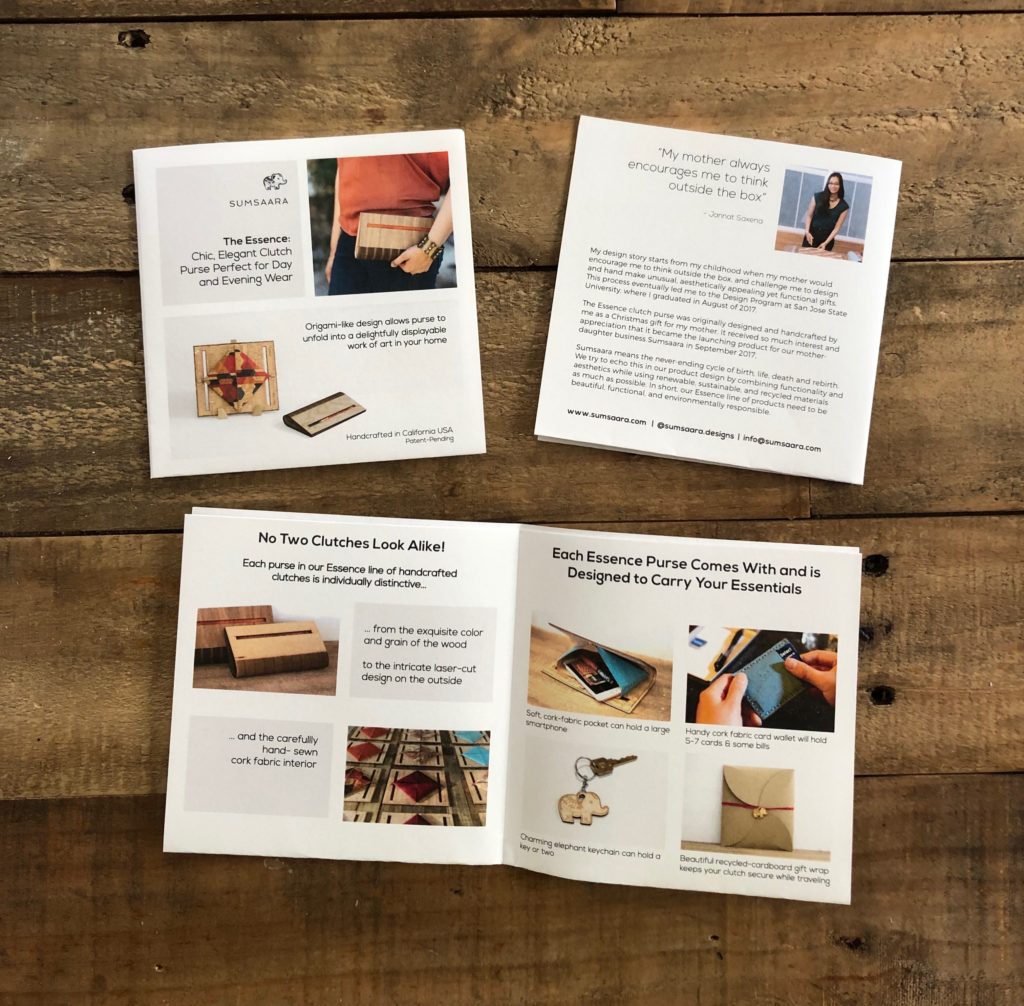
Sumsaara was able to successfully incorporate key messages and story frame into their website and collateral materials, such as a visual brand booklet that accompanies every customer purchase. Also, they are reinforcing their key messages throughout, on flyers that they use as a displayed collateral or as distributed handouts at event showcases that they attend all over the country. Having a compelling story with key messages that resonate with their audience help them increase their brand awareness in multi-fold dimensions. As customers learn more about their intriguing story, they become inspired and make new and repeat purchases as a result.
SUMSAARA’S CHALLENGES:

Sumsaara is a young start-up in the Silicon Valley, led by a high-caliber, mother-daughter team. The company wants to develop a set of key messages that they can articulate in their story and marketing materials. They also want to communicate the dual purpose of their product, encouraging customers to maximize use of their signature product line as a wearable as well as a displayable work of art.
SOLUTION:
We assisted Sumsaara in developing their story frame and message set, coupled with guidance in defining their positioning and product differentiation. Sumsaara now has a story and message framework from which they can apply to their marketing assets and generate excitement and awareness building among their customers.
##
ProTip: Ask us about how to elevate your marketing assets, with storytelling straight from the heart, generating more incremental awareness for your brand!
This July, I’ve the privilege of giving a short talk to a group of first-time founders at the San Jose State University’s (SJSU) SpartUp Summer Intensive cohort.
I gave a talk about “What it Takes Going from Pre-Launch to Launch” using a modified speaking style with a mentorship mindset. It was an interesting experience because I was able to inject more conversational discussion and intentional advice that gave me an energized outcome. conversational discussion and intentional advice that gave me an energized outcome.
One of my advice to founders launching their early-stage products is to be mindful about where they are investing their time and energy to create impact that aligns with their vision.
Throughout the talk, in addition to sharing perspectives and mechanics on launching a product, I also spent 1:1 time mentoring individual founders.
One of the founders popped a question about how to scale when their product has received traction, yet their growth is constrained by the space that they were able to use to market their service.
I paused and asked him to peel back his story a bit. Through our discussion, we’ve uncovered that while his goal is growth, is his company ready for growth? After studying a few facts, I recommended a few readiness actions to consider before scaling for growth, such as:
- Building a committed team to align with more customer reach
- Encouraging more repeat buys from loyal users by offering package sales,
- Finding strategic location to scale that reaches his company’s desired demographics, and
- Making sure there’s consistent revenue flows to support the growth.
So, the teaching moment is that while a young company has a strong desire to grow after they have had successes with marketing their services and users are biting, doing due diligence on factors that can contribute to greater success is important before you scale.
Growing too fast that amplifies your problems instead of successes may not be the right strategy and timing to scale.
Like what you are reading? Please comment and share!
 In this month’s blog, I am giving another follow-up on my conversation about “Laws of Attention” paradigm that I’ve been observing and experiencing. In this month’s blog, I am giving another follow-up on my conversation about “Laws of Attention” paradigm that I’ve been observing and experiencing.
My last blog focused on one of the tips to get attention in a noisy world by “Bringing Your Best Energy to Work Every Day.”
Now, I’d love to elaborate on another tip and double down on our conversation on Laws of Attention: “Showing Up as a Leader Consistently.”
A leader in my definition doesn’t need to be someone with an executive title. It’s individuals whom I believe act as leaders when the situation or occasion needs it. To me, someone who shows up as a leader consistently is a person with great fortitude, strength, authenticity, and compassion to lean into a situation and lead, or champion an issue when no one wants to take on, or when everyone turns a blind eye at an important issue that needs to be addressed.
In my humble opinion, here’re some examples on how you can “Show Up as Leader Consistently:”
Listen before you speak.
We often see leaders who feel compelled to speak at all times because that’s what a leader is expected to do. This is not true under all circumstances. Leaders who show up consistently are ones who not only listen with their ears, they also listen with their eyes and hearts — It’s one of the best traits that I see in leaders who inspire people every day. Because when leaders listen and understand their teams first before they jump in to speak and make all decisions, they are developing trust and strong engagement with their teams to perform at higher level.
Speak up when others are silent on issues that you care about.
Sometimes the issues can be controversial. Yet if you care about it deeply, and can act as a neutralizer and a problem solver, you can ignite the fire in others. As a result, people will rise up and use their voice to support issues or situation requiring a collective voice. When the silence is broken, more people will chime in and you’ll become a leader who allows people to express freely, creating ripple effects that will deliver powerful impact.
Not being in the “driver” seat at all time is good leadership too!
Being a leader consistently doesn’t imply that you’ve to be in the spotlight and driving every decision for your team. Letting go of your ego and letting other capable team members to be in the driver seat can be intimidating because you fear that you’re losing control in decision-making, whereas the opposite is true. When you let go and delegate decision-making of a situation to someone or a team whom you trust, you can still be a leader in the decision-making process by being supportive. This way, you are strengthening that person or your team’s confidence in their own decision-making. When your people are confident about what they do and their future, they’re likely going to perform better on a consistent basis. Hence, you are showing up as a leader consistently in powerful ways.
These examples came from my own experiences in showing up as a leader consistently. When you do, people will pay attention because you’ve shown authenticity, integrity, and courage, all of which are soft skills that some leaders are struggling with to incorporate into their human connection.
If any of the tips highlighted above resonates with you as a leader, please drop a comment. I love to hear your thoughts!
|
|
|