Product Pairing for Holiday Promotions
With the holidays fast approaching, one of my top-of-mind marketing tips for business owners is to focus on product pairing.
You can pair products into bundled offering within your own portfolio, or you can pair your products with complementary goods or services to deliver special gift-giving values.
For examples:
You get the idea!
So what makes a product pairing powerful enough that buyers come back for more?
Let’s look at the experiences these pairings deliver.
One makes the other better.
Wine and cheese work because each one changes how the other tastes. The wine refreshes the palate, the cheese softens the wine, and the last bite is as good as the first. That’s the first test of a strong pairing: together, the two create something neither creates alone.
A loofah on its own is a tool. Paired with a gentle body cleanser, it becomes a ritual. Your buyer gets something that works together from the first use, and they don’t have to figure out the second piece on their own.
It tells a story.
Tea and holiday cookie recipes don’t just fill a basket. They paint a picture: a warm kitchen, a slow afternoon, someone you love sitting across the table. People don’t buy gifts as products. They buy the moment the gift creates.
The most memorable holiday pairings help your buyer imagine that moment. A soy candle and a paperback novel becomes “a quiet night in.” A bag of locally roasted coffee and a handmade mug becomes “a better Monday morning.” When you name the moment, your customer can see exactly who the gift is for.
It takes the guesswork out of giving.
Holiday shoppers are tired. They’re juggling lists, budgets, and a calendar that fills up faster every week. A thoughtful pairing does the hard part for them. It says, “We already thought this through, and it’s ready to give.”
This is where small businesses have a real advantage. You know your customers. Use that knowledge to build pairings that feel personal, not generic. Ease is a gift, too, and your buyers will remember who made their season a little lighter.
It shares values, not just shelf space.
Some of the strongest pairings come from partnering with another business. A local bakery and a neighborhood coffee roaster. A natural skincare maker and a studio that weaves organic cotton towels. A bookshop and an independent candle maker down the street.
When you choose a partner, look beyond whether the products match, such as:
- Do your values match?
- Do you both care about sourcing, sustainability, or supporting your community in similar ways?
Customers notice when two brands genuinely belong together. A values-aligned partnership builds trust for both of you and introduces each business to a new circle of loyal buyers.
Your Turn: How to Create Your Own Holiday Pairing
You don’t need a big budget or a complicated plan. Here’s a simple way to start:
Start with your customer’s moment. Think about where your product shows up in your customer’s life during the holidays. Hosting a dinner? Winding down after a long week? Thanking a teacher or a coworker? Build your pairing around that moment.
Also, look at what people have already bought together. Your sales history is full of clues. If customers often pick up two items in the same visit, that’s a pairing waiting to be named.
Here are 4 things to keep in mind as you work through developing promotion partner(s):
- Choose one or two partners, not ten. If you’re collaborating with another business, keep it simple. One strong partnership is easier to manage, promote, and deliver well.
- Give it a name. “The Cozy Night In.” “The Host’s Thank You.” “The Monday Morning Kit.” A name turns a bundle into a gift and makes it easier to share on social media and in your newsletter.
- Price it honestly. A pairing doesn’t have to be a discount. Its value comes from the thought, convenience, and presentation you put into it. If you do offer savings, keep them clear and fair so the offer feels generous, not gimmicky.
- Tell the story everywhere your customers are. Share the pairing on Instagram and Facebook with a photo that captures the moment. Introduce your partner business on LinkedIn and talk about why you chose to work together. Feature the pairing in your e-newsletter with a short note about who it’s perfect for. One good idea, told consistently, goes a long way.
Have a pairing idea but no time to plan and launch it? Contact me and put “gift-giving” in the subject headline. I will be in touch, and we can work on mapping out a holiday campaign built on organic social and word of mouth.
PC: Marie Despeyroux on Unsplash
Word of Mouth Marketing Is Back
Word of mouth marketing is the analog way of marketing, and it still works.
Funny, lately I’ve been picking up a lot of vibes that small and medium-sized businesses are tired of posting organic social media that doesn’t convert.
In the past few weeks, I’ve had two separate conversations with two different clients who are going back to the tried-and-true method of marketing: word of mouth.
 Your greatest sneezer! Neither business has scaled yet. They’re building solid foundations in their marketing, business development, and client and community relationships, so they can grow their customer base on something real.
When they told me about their word-of-mouth (WOM) plans, I supported the direction right away. I know how hard they’ve worked to earn those relationships, starting with their very first customer.
So, I encouraged them to lean into WOM and partnership marketing first. Then, once they know what’s working, use organic and paid social media to amplify their stories on platforms where their audiences are spending time.
Here are a few thoughts on both of my recommendations:
1. The Power of Word of Mouth: What You Need to Know
It’s free, and it multiplies with efforts. WOM costs you no ad budget. It costs you attention, consistency, and care. Every conversation, follow-up, and thank-you note is an investment. The return is trust, and no algorithm can manufacture that for you.
Find your sneezers. Seth Godin calls them sneezers: the people who can’t help but tell others about something they love. They’re your ambassadors. Look at who already refers you, who keeps showing up, who brings a friend along. Often, they’re hiding in plain sight among your earliest customers.
Give them a story worth repeating. People don’t pass along products. They pass along stories. Why you started. The problem you solve. The moment a customer’s day got better because of you. Make your story simple enough to retell over coffee, and true enough that they feel good in retelling it.
Engage them with care. Sneezers share because they want to, not because you asked them to perform. Ask for their opinion. Share early news with them first. Thank them, privately and (with permission) publicly. A handwritten note still goes a long way.
Let them in. Give your sneezers an “in” so they feel like part of the team. A sneak peek at a new product. A seat at a small customer roundtable. When people feel ownership and valued, they speak up with pride.
Listen to what they say. WOM runs both ways. The words your customers use to describe you are gold. Write them down. They’ll become your messaging, your headlines, and eventually your social media captions.
2. The Power of Partnership: What You Need to Know
It’s free for both parties, with reciprocated marketing. Partnership marketing means two businesses sharing audiences they’ve each earned. A co-hosted workshop. A bundled offer. A feature in each other’s newsletters. No ad spend, and twice the reach.
It requires a shared vision. The best partners serve the same people in complementary ways. A yoga studio and a local juice bar. A sustainability consultant and a B Corp accountant. Ask yourself: do we care about the same customer outcome? If the answer is yes, you have somewhere to start.
It requires trust and appreciation for each other. When you partner, you lend your reputation, and so does your partner. Choose people whose values you’d vouch for, and say thank you often. Appreciation keeps a partnership generous instead of transactional.
It requires deeper relationship building. Partnerships rarely come from a cold pitch. They grow from coffee chats, community events, and showing up for each other before there’s anything to gain.
It requires high effort from both parties. A partnership where one side does all the work won’t last. Agree upfront on who does what, how you’ll share results, and what success looks like for each of you. Clear expectations protect the relationship.
Start small. Try one joint project before committing to anything long-term. You’ll learn quickly whether the fit is right, and a small win builds momentum for the next one.
From Analog to Digital
If you’re an SMB at an early stage, keep these two tools at the heart of your formative marketing strategy. They teach you who your people are, faster and more honestly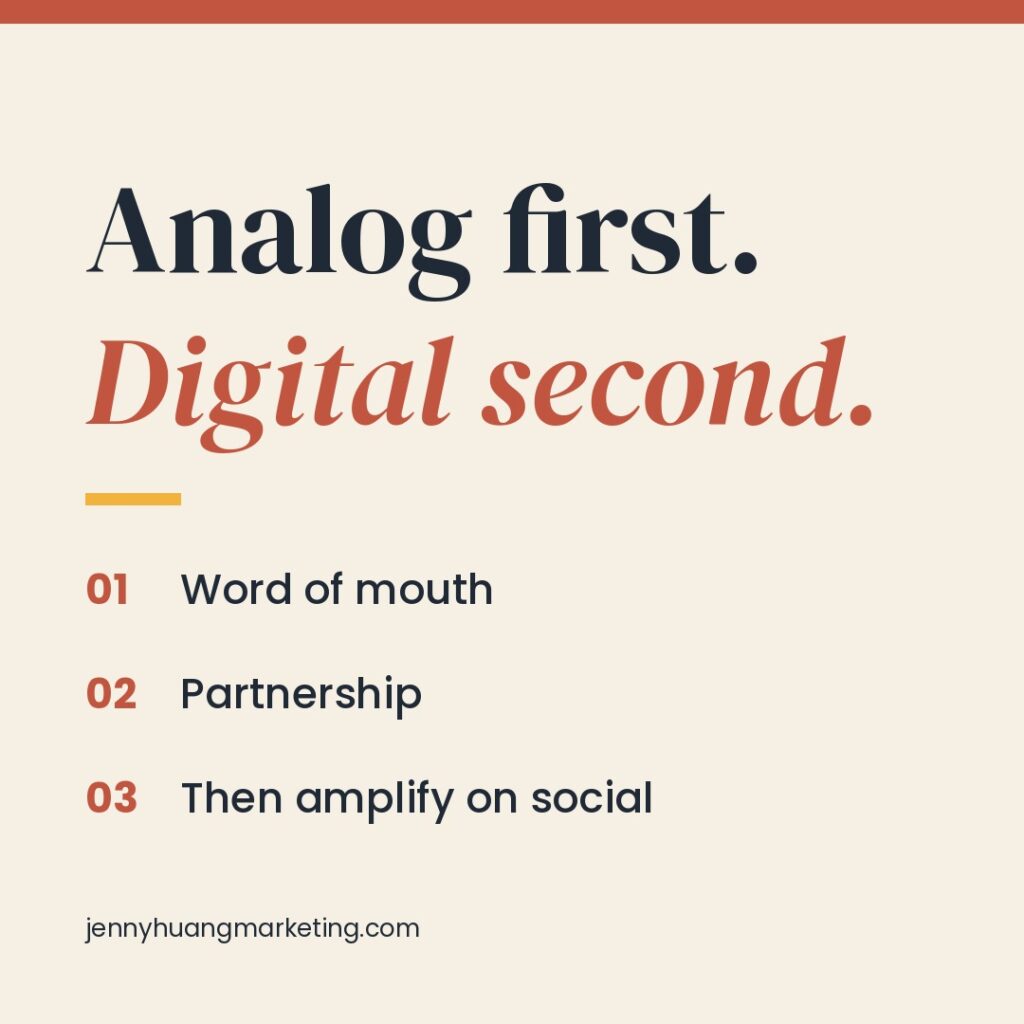 than any dashboard. than any dashboard.
Once you’ve found the right customer tribes, you’ll know the formula you used to attract them. Then carry that formula onto social media: build customer profiles based on real people, and use AI to help identify similar businesses and audiences who want what you offer.
With a customer tribe in hand, you’ll give AI and social media much clearer direction on who you’re looking for and what results count as success.
So go do your analog marketing. In a crowded digital world, a real conversation stands out. It’s a breath of fresh air in a space that sorely needs one.
If you’d like guidance in shaping your WOM and partnership strategies, book a discovery call with me. I’d love to get to know your business and figure out how I can best support your growth journey, from analog to digital and everything in between.
Cheers! Coach Jen
Amplifying Human Values Hard to Replicate
Recently, I have been doing more incremental training on Claude as a marketer. While I am learning to test and re-test if Claude’s AI approach can help me be more efficient in my workshop training and writing projects, I’ve also learned that it takes quite a bit of time to train AI to think like me.
As I am going through my training, I pause from time to time to reflect on my philosophy about how we should integrate AI into our daily work and personal tasks.
I have always been a believer in keeping skills and superpowers that I own and not outsource them because they are non-negotiables – something that I continue to see as values that I bring to do my best work.
My values are my own experiences, struggles, intuition, perspectives, judgement, and stories that come to shape how I see things, hear things, learn things, feel things, analyze things, and connect with others.
 Amplifying Human Values Human Value Awakening
While I am trying to be better at working together with AI to do great work, I have been reminded by an Instagram podcast clip of Seth Godin who raised the message about creating values in our human work. Godin is an American author, entrepreneur, and marketing expert known for changing how people think about modern marketing, leadership, and work. I’ve been following Godin because of his worldly wisdom and interesting things he said that wake people up.
What Godin said in that interview clip woke me up; it landed with me because I think we all need to be more aware and conscious of our superpowers, what we are good at that comes easily, and what we love to do that we don’t want to have someone else do it for us.
This thinking is what has prompted me writing this blog. My intention is to help us start navigating what we want to own as humans, and what we can work with AI together to do our best work.
Here’s an early process that I’ve developed to help us continue in exploring our values as technology evolves over time, and hope it resonates with you:
I. Defining What You as a Human Want to Own
Ownership is about something that you choose to hold onto, take responsibility for, and get better at it – not something that you want to outsource or let AI do it for you.
Before you can blend human and AI strengths, you need clarity on what you’re not willing to hand off, regardless of how good the technology gets. This starts with naming the human values that define how you work.
Some of these are:
- Human judgement under ambiguity: When the data is incomplete, the client is unclear about what they want, or the situation has no precedent, someone has to make a call. That would be you.
- Human empathy built over time: Consistency, follow-through, and a willingness to be vulnerable with a client — these compound slowly, and they can’t be automated into existence.
- Ethical accountability: When a campaign misfires or a strategy backfires, someone has to own it, explain it, and make it right. AI doesn’t carry that weight.
- Human intuition in the room: The unspoken tension in a meeting, the hesitation in someone’s voice, the moment a client needs reassurance instead of another uncertainty — this is read-through emotion, not calculated from data.
- Human perspectives shaped by lived experience: Your point of view is shaped by everything you’ve lived through. Human lived experiences bring texture that data alone can’t replicate.
Notice that none of these are about resisting technology. They’re about preserving and protecting the parts of you or your work that depend on human emotions and human perspectives in the first place — and being honest with yourself about what they are.
II. Defining What AI is Good at and Can Own
Identifying tasks for AI to do is not about cutting corners. It’s about freeing up your time for the work that only you can do and love to do, because you’ll get energy from doing them.
For example, AI is exceptionally good at:
- Pattern recognition across large data sets: spotting trends a person would need weeks to find manually.
- Speed on first drafts and variations: giving you ten headline options in the time it takes to write one.
- Consistency at scale: keeping tone, formatting, and compliance steady across hundreds of assets.
- Research synthesis: pulling together sources and summarizing them quickly and clearly.
- Removing repetitive admin: freeing up hours that used to go to formatting, scheduling, or basic reporting.
I have delegated AI to do some of the items above, especially items 1 and 4, and I do the final checking to make sure the output makes sense to me and to my clients.
III. Blending Human Values and AI to Achieve Best Work
The idea here isn’t about choosing AI or choosing human efforts. It’s about knowing when human should lead and own and when AI can assist.
For examples:
- Strategy and positioning: Human leads. AI can stress-test assumptions, but the direction has to come from you.
- Drafting and variations: AI leads based on your prompts. Let it generate volume and options; you edit for voice, nuance, and fit.
- Client relationship moments: Human only. Difficult conversations, negotiations, and moments of reassurance don’t belong to a machine.
Think of this process less like a handoff and more like a relay — you’re both running, just not the same leg of the race.
Sometimes it’s tempting to hand off the parts of your work that build long-term trust and let AI do some of it.
Trust is built in the moments that feel small and are easy to automate away — the personal follow-up, the handwritten note, the extra five minutes on a call. Protect those deliberately.
It’s also worth checking your negotiables and non-negotiables regularly. What made sense to keep human-led six months ago might be a place where AI can now safely take more of the load — and vice versa. Treat the framework above as a living document, not a fixed plan.
IV. Creating and Amplifying Human Values to Grow Together with AI
Here’s a mindset that we need to continue to practice: continue practicing your human values; values that go unused don’t stay sharp. Like any skill, they need growth and repetitions — especially human judgement and human intuition, which can become rusty if we don’t continue to exercise and use those muscles.
A few ways to keep building:
- Practice human judgement calls on purpose: Before reaching for an AI draft, sit with the ambiguity for a few minutes first. Make the call yourself, then compare.
- Seek feedback from real people: Not just engagement metrics. Metrics tell you what worked. People tell you why — and that “why” is rooted in human emotions.
- Stay curious about the “why”: It’s easy to see that something resonated. It’s more valuable to understand what made it resonate, which usually traces back to human perspectives you hadn’t considered.
- Mentor someone: Teaching a skill is one of the fastest ways to keep your skills and values fresh and sharpened.
- Revisit your non-negotiables list regularly: As AI capabilities shift, what you choose to own might shift too. Don’t let that list go stale.
One thing that Seth Godin reminded us is that the “more human you can be, the harder you are to be replicated.”
Having a healthy mindset that embrace technology, knowing your superpowers and constraints will help you amplifying human values that will keep you at pace, and stay relevant in this digital and AI world.
V. Key Takeaways to Keep You Grounded as AI Evolves
Here’s is a quick recap:
- Decide, deliberately, what human values you will never hand off — and revisit that decision often.
- Recognize AI’s strengths and limitations, so you can focus fully on what you do best.
- Sequence your work: let AI lead on speed and scale, and lead yourself with human intuition, judgement and empathy.
- Treat human perspectives and human intuition as a premium, and continue to go out there to get experiences, build relationships, and gain perspectives that will make you more human.
Don’t let the fear that you will be left behind if you don’t adopt AI 100% in what you do. Keep yourself grounded because you know your capabilities and superpowers; you’ve test drove and stress-tested them. When you’ve gained experiences through your struggles and walked those paths yourself, you will know what to change to make it better or more efficient by using technology.
You will then be a better teacher to your clients or AI-assisted tasks because you know what you are asking, and what you are looking for in the output. This will make you feel more satisfying about using technology not for its sake, but for its ability to help you be even better at what you love to do.
Want a simple way to track what you’re choosing to own as AI evolves? Click here to download a copy of your quarterly human non-negotiables checklist.
Leading Business and Life with the Heart of a Champion
Watching the FIFA World Cup 2026 has triggered a potent thought in me about how elite soccer teams won their battles playing in tough and competitive environments.
In my opinion, definition of a champion means Role modeling your values and beliefs in all facets of your life, living and leading like an authentic champion.
Leading and Playing with the Heart of a Champion
 Living and Leading Business and Life with the Heart of a Champion One thing that stood out in all winning teams such as France, England, Spain, and Norway, — without intentionally single out any teams – is that they led and played like world champions.
Champions don’t necessarily mean that they are guaranteed winners in all the games they played. Champions in this blog’s context mean that the team, the sponsored country, and all individual players all wore on their sleeves values and beliefs of champions, regardless of circumstances that they were under.
Role Modeling Heart of a Champion
When athletes played with a heart of a champion, their presence and influence go beyond just the physical and skill aspects of the game. It means that players and their team as a whole, exemplify “champion” spirits and behaviors, living and breathing their values on and off the field.
Big things such as scoring goals, playing with classy sportsmanship, winning the game with a single purpose in mind, getting to the next game, relationship-building and communicating, and not leaving their fans and people behind.
They do things that make themselves proud, their country proud, and their families proud.
All players and coaches from the winning teams embrace “the heart of a champion” attitude because they all believe in themselves, the ability of their teams, and that together they can make a difference. Their presence and composure showing up in games — even when they were under attack by opponents – and in social environments, said a thousand words about who they are and what they are made of. Collectively, their actions and behaviors continued to role modeling good sportsmanship, and became lessons that are going beyond game zones into other facets of their lives.
Business Sportsmanship Mirroring Athlete Sportsmanship
There is so much parallels in how business owners conduct ourselves and lead our teams that mirror athlete sportsmanship.
First, to lead others, we need to be able to articulate our vision and bring people onto the same bus with us.
Second, to influence others, we need to build trust so people will follow and act upon what we believe in together.
Third, to get adoption from customers, we need to convince them to play and work with us, and know that we’ll take them onto a better place when using our products and services.
Fourth, to receive love from our customers, we need to love ourselves first; so we can have the overflows to love others, lifting others up with things get tough and celebrating when things are done well.
When businesses lead from the heart of a champion, we’ll win hearts and minds of our customers and stakeholders. Because the ripple effect of a champion has the magnetic power to unify people behind you, cheering for you when you are up, and consoling you when you are down.
I’ve witnessed these same emotions in this FIFA World Cup where I see fans who cheered for the champions, celebrating when they went through the ups, and lifting them up when they went through the downs.
Imagine if you and your business wear the heart of a champion on your sleeves, getting this kind of fan love, the energy will be explosive and unstoppable. The attraction to your business will become phenomenally viral and electric – that’s a feeling that any business would simply love to have and own.
Question for you:
How would your business sportsmanship emulate elements of athlete sportsmanship to win customers and amplify your brand? Contact us to get some ideas on how we can help you get there.
Competing Against Yourself
 Pele’s famous backward bicycle kick (Credit: AP) “Competing against yourself” is the answer that I received when I once asked an athlete about how she was able to keep up with her competitive swimming rivals.
It’s funny how this concept can be applied to our business and marketing too!
As a business owner or founder of a company, we all have similar concerns when we are up against issues related to our product, our sales, our operations, or our marketing.
Often, we may look to outside factors and place frustrations on competitors, state of the industry that we are in, or the current economy that could be affecting the health and growth of our business.
Yet we don’t look consistently from the inside and ask how we can do better. Whether it be with our product, our process, our operation, our marketing, or our efforts in learning new things to win in our business and marketing.
Staying Competitive, Mentally Focused and Motivated
When we as a business owners or founders who did not grow up playing sports, we may not be trained like athletes in having the mindset that will help us do better under high-pressure. That means staying competitive, mentally focused and be motivated at all times to finish a game – win or lose.
We tend to compare ourselves with others. When the better method is to compare our efforts with what we have done previously – and figure out how to beat our previous records.
Because when we strive to bring our product or service to be a better version at the next round, we’ll always improve and gain more from learning our own mistakes and do better next time.
Asking questions such as:
1) What costs can we trim so we can keep expenses in check while buffering from revenue reductions due to a soft economy?
2) What tasks that we can automate so we can focus more on building relationships for our brand and flows for our pipeline?
3) What mindset do we need to adopt so we can stay resilient and be continuously inspired to be in business, and come out stronger on the other side?
4) What are new frustrations that we are sensing from others that we can turn those ideas into relevant products that other people want?
Elites Look Inside. Averages Look Outside
Like author of Atomic Habits, James Clear, said: We are elites when we look inside to make the right changes or transformation to succeed, instead of looking outside and shifting blames to your rivals, suppliers, bad lucks, or other reasons.
Similarly, like the swimming athlete that I talked to at one point…her goal is to meet or exceed on her own records. So she can continue to stay competitive yet not get distracted.
This kind of healthy mindset will keep you going strong and be challenged to bring your business and marketing to a better state – that’s what every business owner or founder want for their endeavors.
Question for you: What are you (or your business) competing yourself against?
Recently, I led a workshop on “Marketing Fundamentals,” in partnership with the Silicon Valley SBDC, to a cohort of small business owners and executives. The workshop was timely because we’re living in a challenging time for marketers (and business owners), where we have a vast amount of technologies and tools at our disposal, clamoring for mindshare as well as their utilities in our marketing toolbox.
In my workshop, I highlighted Evian mineral water as one of the iconic brands that stood the test of time due to the consistency and authenticity in their brand stewardship.
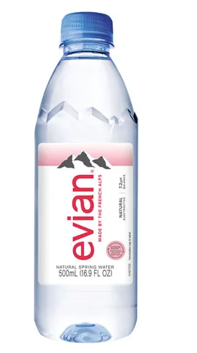 Evian’s clear blue bottle Given one of the focused topics in the workshop is about the 5 Ps in marketing, I used Evian’s brand as a user case because it has been steadfast in delivering on its brand promise, combined with cohesive messaging and packaging that work together to break clutters in distribution channels.
Powerful Branding & Marketing Tenet
Evian’s brand promise focuses on two-words: Live Young; it’s also the brand’s tagline. These two words carry the entire brand. In three seconds on any retail shelf space,
you see the Alpine source and the clean bottle. It shouts out that “You’re not buying hydration. You’re buying a feeling of being refreshed, youthful and alive.”
Everything Evian does is engineered to land that feeling instantly:
The bottle — Elegant, curved, minimal. Before you taste it, the shape tells you this is different from everything else on the shelf.
The name — Évian-les-Bains. French. Alpine. Instantly sounds expensive and pure.
The visual — Mountains. Blue. No clutter.
The positioning and tagline — “Live Young” doesn’t explain the product. It promises a feeling.
The origin story — “Filtered through glacial rock for 15 years” makes you feel like every sip has been perfected by nature itself, always natural mineral water.
Elevating Brand Portfolio to Increase Consumer Appeal
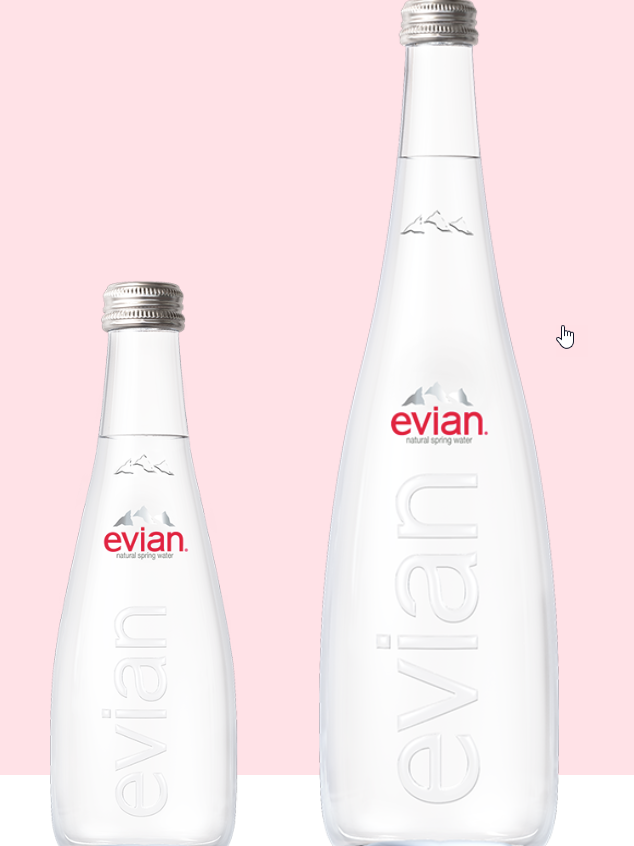 The company has added its iconic Evian glass bottles with elegant touches to include celebration at restaurants and homes. They also added limited editions annually to keep surprises in the wrap for consumers. They partner with iconic sport athletes such as Carlos Alcaraz. Carlos joined the Evian family as a global ambassador, embodying the brand’s energy, ambition, and Live Young spirit. The company has added its iconic Evian glass bottles with elegant touches to include celebration at restaurants and homes. They also added limited editions annually to keep surprises in the wrap for consumers. They partner with iconic sport athletes such as Carlos Alcaraz. Carlos joined the Evian family as a global ambassador, embodying the brand’s energy, ambition, and Live Young spirit.
Sustainability Actions Speak Louder than Words
On top of being an exemplary brand, Evian is a socially-responsible company.
The company’s sustainability actions support these 3 pillars:
1. Packaging and Recycling
2. Source protection
3. Climate impact
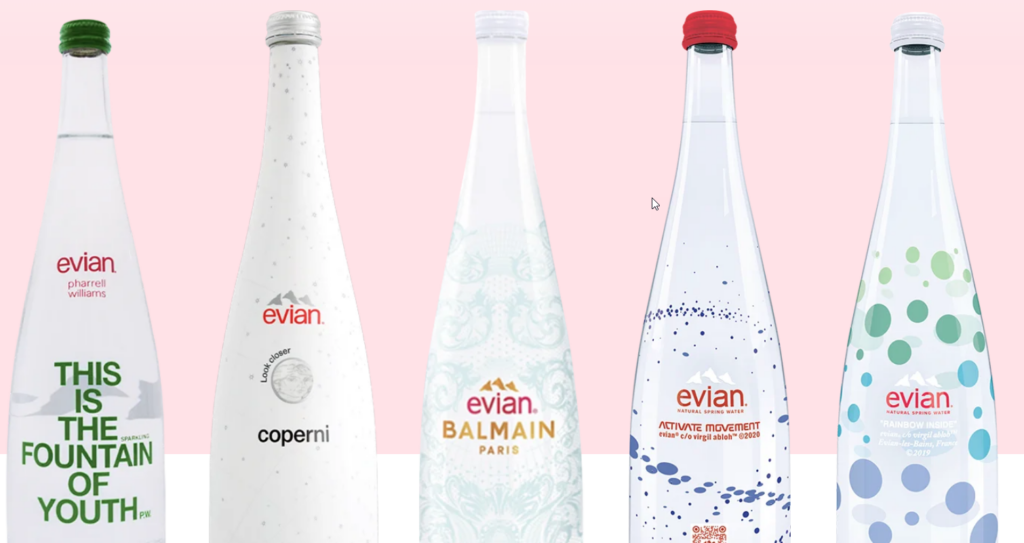 Evian’s Limited Edition On packaging and recycling, Evian has transitioned from a linear to a circular economy of sustainable packaging. As of May 2024, 100% of Evian bottles* manufactured for sale in the US are made from 100% recycled PET.
On source protection, Evian also has created the Water Institute by Evian to train future hydrogeologists so they can help Evian treat the water source and its cycle with respect. The hydrogeologists collect samples to ensure that the aquifer (underground water source) is regularly replenished.
On climate impact, Evian is working to reduce carbon footprint on transportation of their bottles. For example, knowing that train transportation carbon footprint is 10x smaller than those of trucks in France, Evian transports about 90% of their bottles from factory to warehouses by train.
Steadfast Brand Stewardship
Evian’s actions and dedications in making their product sustainable and doing all they possibly can to protect the water source and preserve the environment speak volumes about their brand stewardship. That’s why consumers never forget a brand whose fundamentals are unshakable, and whose presence reminds us about what an iconic brand would do to stand strong, evolve innovatively and thoughtfully to stay relevant in this modern world.
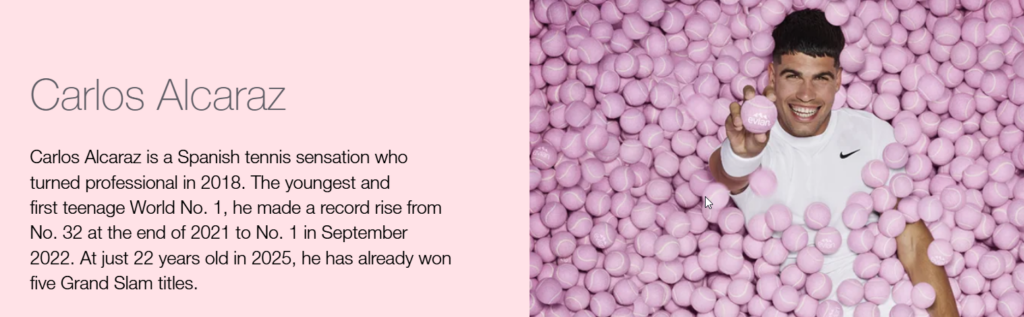 Carlos Alcaraz as Evian’s global ambassador, representing energy, ambition and Live Young spirit. *Excludes labels and caps
All brands and trademarks are properties of respective owners
Source: Evian.com, claude.ai
Workshop: Embracing Your Authenticity and Raising Your Human Premium
Weds, March 25, 10-11 am PST
For founders who are ready to build trust with early adopters and investors…and unsure how steady trust can be built…
 Embrace your authenticity and raise your human premium For progressive business owners who want to be seen as leaders that customers trust to do business with…and unsure how to become a trusted leader…
Authentic personal branding is the catalyst in building trust that will anchor deeply with your customers and investors, winning their hearts and minds.
Authenticity and trust are closely linked.
Investing in building your authentic personal brands needs to be a priority in your journey.
That’s why I would like to invite you to my Free, virtual workshop: “Embracing Your Authenticity and Raising Your Human Premium”
On Weds, March 25, 10-11 am PST.
In this 45-minute workshop, I will be sharing with you the “Why’s and How’s” to build your authentic personal brands on social and digital media, with ease and confidence.
You’ll gain insights on:
1) Authentic personal branding allows you to compete and thrive
2) Getting started in building your authentic personal brand
3) Augmenting your existing personal brand to become more authentic
4) Raising your human premium in the age of AI
Bonus: Attendees get early access to my 4-week authentic personal branding private coaching, limited spots.
Join me on March 25, 10-11 am PST!
Must register here to get the Zoom link to attend.
See you on the inside!
Coach Jen
Anchoring Authenticity for My Personal and Business Brands
 The raw, direct, and less-polished authentic personal brand In the last 4 years, I have lived and breathed authenticity into my personal and business brands like never before.
The rush behind it was not by design; it was a choice that I’ve made to expand my personal growth.
Leading with an authentic personal brand was not easy in the beginning, because I was trying to understand and define what “authentic” means to me, by doing the inner work that gives me permission and freedom to fully express who I am.
There were moments that I had doubts about how others will accept my truths and vulnerabilities.
Being vulnerable put me in spotlights that I felt I had to be ready to defend my thoughts and protect my safety, on things that were normally private to me are now made for public consumption.
Over the years, as I peeled back the layers of my story steadily and courageously, I’ve built confidence in my voice, and that becomes an extension of my personal brand, which permeates into my business brand.
I’ve learned a lot about myself, and at the same time, a lot about others because people opened up when I opened up.
Modern World Craves Real Person In Full Presence
In this modern world where we have access to tools that can transform an image from a normal person to one that has a scripted edge and feel to it, it makes the craving for “a real person” even stronger.
The identity that I’ve grown into and embraced is one that reflects my true self: calm, grounded, intentional, forgiving, full of self-love and love for others.
My authentic personal brand has become a love connection to my business brand because they’re in separable.
A strong, authentic personal brand in full presence influences my energy, my thoughts, and my actions…
…I’m not afraid of dealing with messiness in my life
…I’m trusting my intuition fully
…I’m able to let go and forgive
…I’m able to lead without constant judgement of myself and of others
… I’m able to love again even when I feel I was broken
…and I feel free in amplifying my voice with greater intentions
The raw, direct, less-polished, authentic personal brand is raising my “human premium” that I won’t trade it for anything else.
Who is with me?
 Marketing During Uncertain Times “Value-First” and “Human-Centered” Marketing Wins During Uncertain Times
During the past few weeks, the heightened chaos and instability happening in Minnesota and around the world woke me up.
I was having a hard time deciding on what topic that I want to share this month for my blog.
After doing some reading on concerns other business owners have, I’ve decided to write something to help some of you who may be in the same situation as I do: How do we continue to market our business during uncertain times and not make it tone-deaf and too sales-oriented?
In my opinion, I believe the most effective approach would be using “value-first” or “human-centered” marketing.
Value-first means that you offer values to help people feel better, lighten their stress level, reduce their loads, or help them get productive even when they may not feel motivated.
Human-centered means that you focus on your customers with empathy, kindness, and forgiveness that will make you a better person to help them navigate reality.
This means Instead of pushing products, you’re genuinely helping people navigate the chaos and messiness around them, while building trust that naturally leads to brand affinity and sales over time.
What are some ways to articulate “value-first” or “human-centered” marketing?
Consider these nuggets:
- Lead with useful content and support. Share practical information related to your expertise that helps people solve real problems they’re facing right now. If you run a financial services firm, create content about managing uncertainty or stretching budgets. If you’re in wellness, address stress management. The key is making it genuinely helpful, with less focus on sales pitch.
- Acknowledge reality without dwelling on it. By acknowledging reality with a simple recognition goes a long way. Something like: “We know these are uncertain times” before explaining why you’re there to help. Then move forward constructively rather than amplifying anxiety.
- Emphasize community and connection. People crave belonging and love when the world feels chaotic. Create spaces for customers to connect with each other, share stories from your community, highlight how communities coming together can strengthen faith and trust to move forward. This builds emotional bonds that transcend transactions.
- Be transparent and reliable. In uncertain times, consistency is comforting. Communicate clearly about your offerings, pricing, and availability. If you need to make changes, explain why. This reliability becomes a form of value itself.
- Show rather than tell your values. Instead of grand statements, demonstrate what you stand for through actions, such as lending a voice to someone calling out bad behaviors, supporting marches that express public opinions and your own sentiments, and serving customers with empathy. People notice authenticity and real emotions – which will make them value you even more.
Are these tips helpful for you to navigate your marketing approach in uncertain times? Drop me a line if this resonates and share with your friends and colleagues.
ABOUT PRETTY POKETS:
Pretty Pokets™ is woman-owned business founded by Madhu. Before Madhu started her entrepreneurial journey, she worked as a hardware engineer at Intel. Motherhood served as the catalyst that drove Madhu’s passion as new mom into a business owner creating a real product that had a bigger purpose. Because Madhu firmly believes that women need accessories that provide confidence and simplify their day-to- day lives while adding the much-needed style, her mission is to add incredible value to women’s life by designing and creating intentional products that find harmony between usefulness, common sense, and fashion.

THE RESULTS
Pretty Pokets has made the transition from womanhood to motherhood pretty by empowering moms with practical and elegant products that they are proud to wear and would not leave home without.
Through working with us, we were able to help Pretty Pokets completed their Kiva Crowdfunding campaign from start to finish, and received amazing community support. Her company was funded in 1.5 month since the campaign inception, and gained sufficient funding to move forward with her product expansion.
“Pretty Pokets was was funded in less than 45 days—just before Christmas. It was truly an amazing experience, like having the best gift of the season arriving early. Thanks so much Jenny, for all your help!” — Madhu Challa, Founder and CEO, PrettyPokets
PRETTY POKETS’ CHALLENGES
As a first-time, woman business owner, it was hard initially for Madhu to get funding that will allow her to build prototypes and ultimately develop and expand more product lines to sell to her customers. She took courage to address a big pain point for new moms. Her idea turned into a Patent-Pending Diaper Bag that was useful, functional, and fashionable. She was able to successfully build her prototypes and produce trendy, fashionable products that got real traction. She was ready to move into her next stage of product expansion and looking for funding to support her inventory build and new customer orders.
SOLUTION
We worked closely with Madhu to develop her business profile and campaign pitch that were featured on the Kiva micro-lending platform. We listened carefully to her story and brought curiosity and creativity in our work to help her craft a simple, yet compelling story for her Kiva campaign, which provided tremendous credibility for her business in the Kiva community.
To top this off, because the campaign was launched close to the holiday season, getting attention from borrowers felt like an impossible task. We made it easy for Madhu to work with us and followed up with her throughout the campaign. Together, we worked on pertinent marketing and word-of-mouth support to push the campaign through, until Pretty Pokets was funded – just before Christmas.
|
|
|